
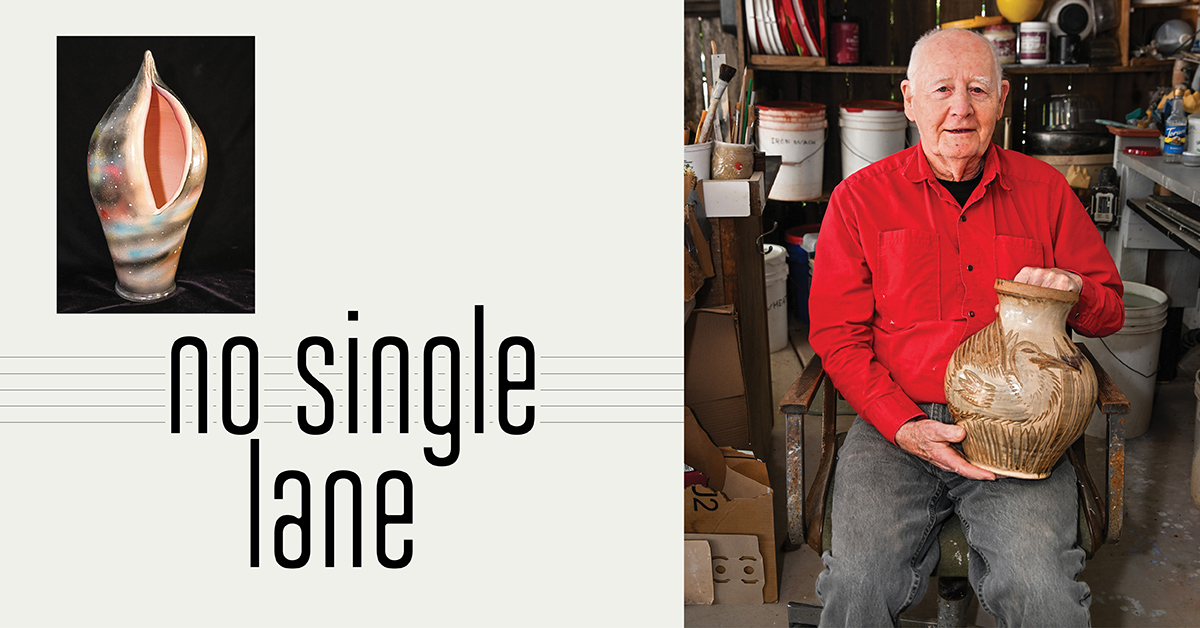
No Single Lane
Paul “Palul” Rideout Still Creating at 85…
Watch Paul “Palul” Rideout at the wheel, and you begin to understand something. His hands move into the spinning clay with a confidence that is almost scientific—deliberate, sure, informed by decades of knowing exactly what this material will and will not do. Then something shifts. The hands begin to feel rather than direct. The form rises not from intention but from instinct. The man at the wheel is no longer a technician. He is somewhere else entirely.
“Making a pot is like writing a song,” he says. “My hands feel the rhythm. The wheel is an artistic instrument. You find the beat, and all of a sudden, you’re decorating with rhythms and imagination.”
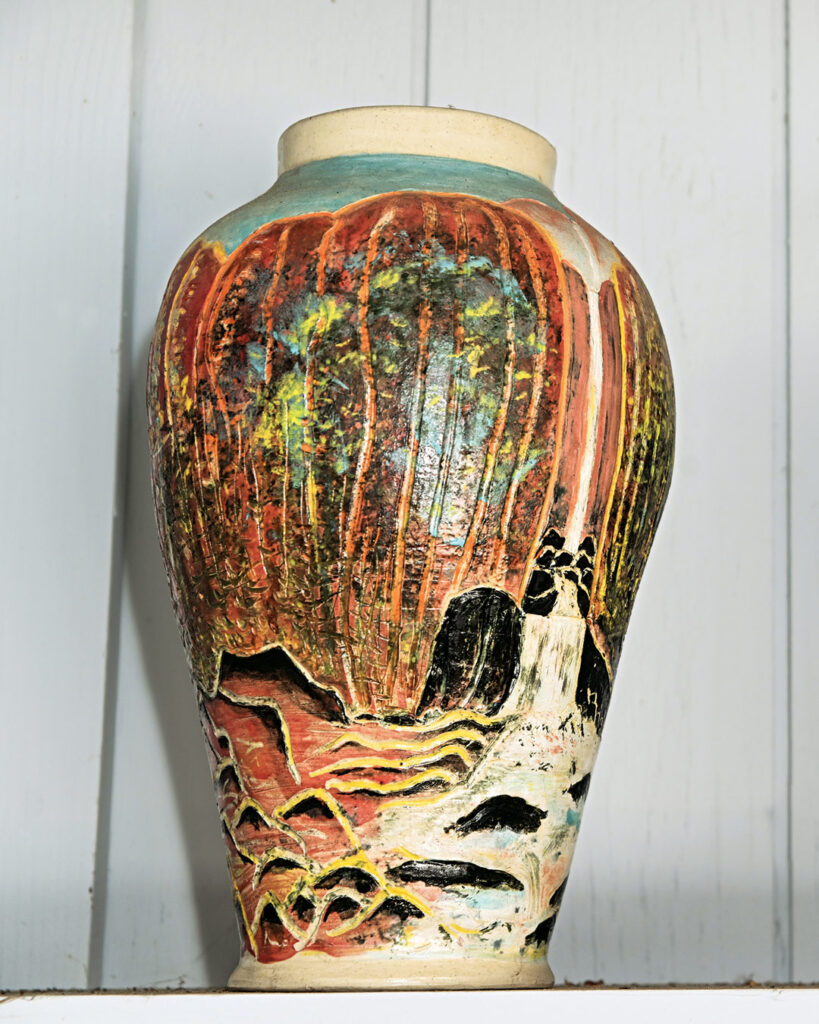
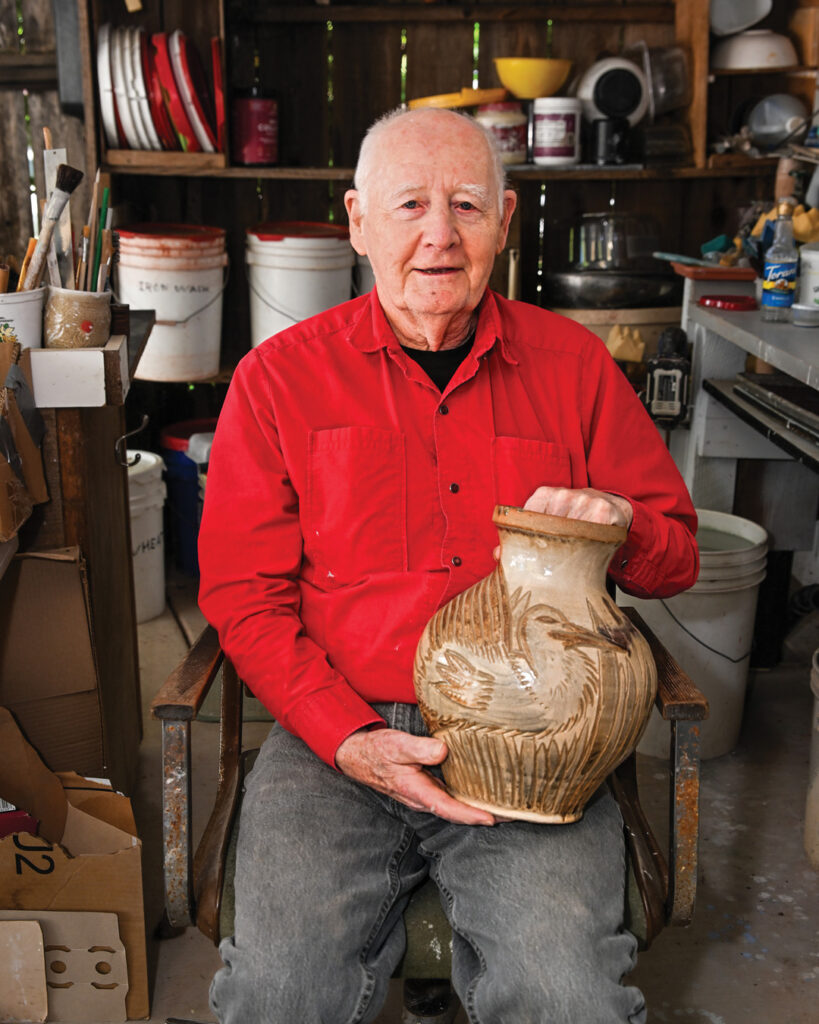
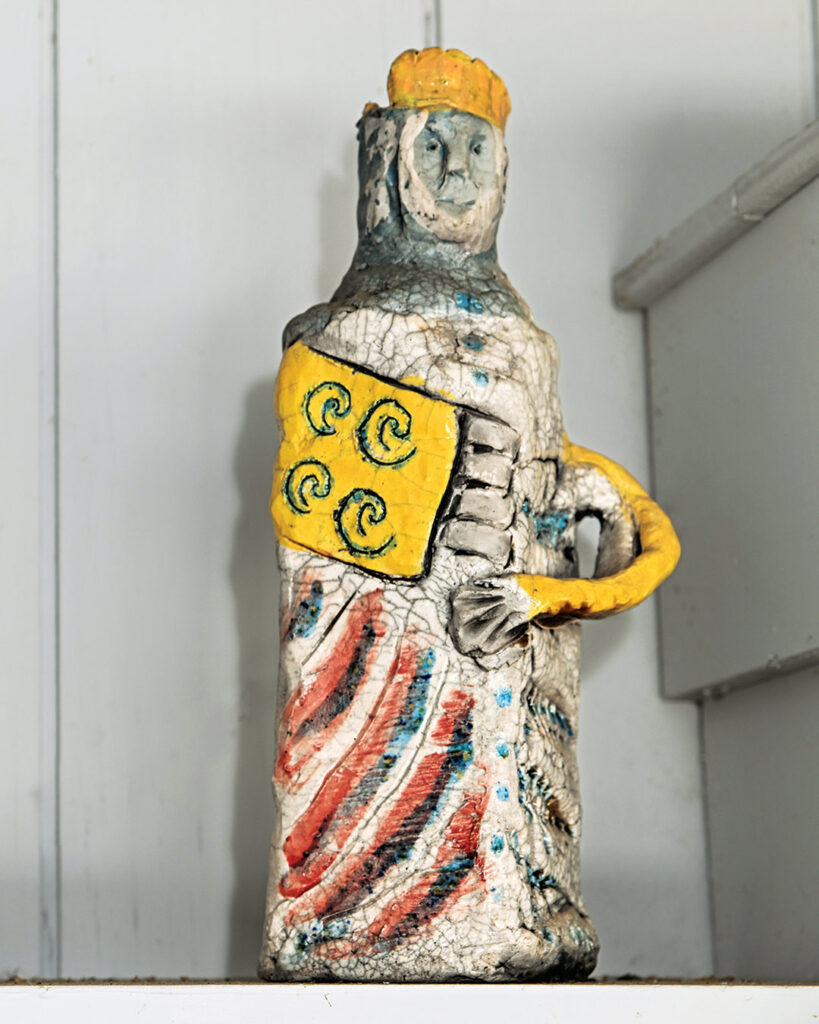
This is the essential Palul—the artistic name Rideout has used for 25 years—a man who has spent his entire adult life navigating the space between two ways of knowing. He holds a bachelor’s degree in zoology with a minor in chemistry and worked in research and clinical laboratories for a good chunk of his life. He is also, after 45 years in clay, a master ceramic artist whose work is collected nationally and internationally. He has written a counterculture memoir, a multi-volume history of ceramics told through historical fiction, instructional guides and a book of philosophical quotes. He taught ceramics at Shasta College in Redding for 35 years.
Now 85 and living in Redding, Palul is still finishing a half-dozen large wall-hanging platters in his studio, still chasing the next idea, still asking the questions that have driven him since youth: Who am I? Who are we? What is our purpose in life?
He is, in the truest sense of the phrase, a Renaissance man.
Palul grew up in New England, and from the beginning, he was pulled in two directions. The scientific mind came first—orderly, empirical, trained to observe and measure the natural world. But the artist was always there underneath, restless and insistent. After graduating from college in the early 1960s, he found a way to feed both: He would work six months at a stretch, save his money, then disappear for the next six. He traveled, he painted, he kept a journal. He showed up in Haight-Ashbury when the counterculture was at full boil. He protested the Vietnam War as a conscientious objector. He wandered from New England to Canada, Hawaii, Los Angeles and San Francisco through desert lakes and Pacific beaches, eventually coming to rest in the mountains of Northern California.
Those journals, accumulated across years of wandering, became the foundation of his memoir, “Vision Quest: A Saga of the 1960s”—a book reviewers have called “a wonderful, introspective yet entertaining romp through the 1960s as seen through the eyes and sensitivity of an artist, yet interpreted and recounted by a scientist with a great respect for nature and native culture.”
One of the book’s themes is the tension between the scientist and the artist within, though Palul himself resists framing it as a conflict. “I kind of see life as waves,” he says. “Ups and downs. One is objectivity, and one is subjectivity. They kind of go up and down. The whole trick in life is to obtain balance between the two.”
The balance he was searching for crystallized the moment he discovered ceramics at age 30. He had a wife, a baby on the way and a lab job that paid the bills. A potter he met offered to show him the craft. “That was it,” he says simply.
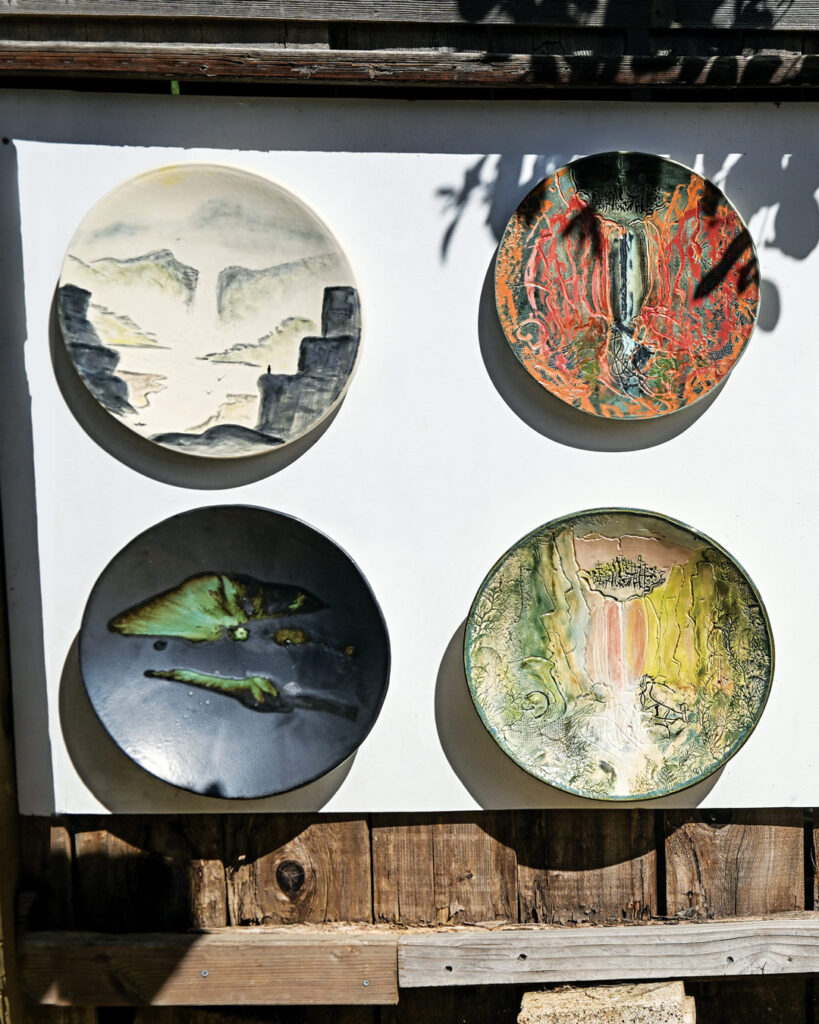
What hooked him wasn’t just the feel of clay or the alchemy of the kiln. It was the way ceramics demanded everything he had—both halves of him. “Ceramics blended art and science in the most perfect way,” he explains. Geology, physics, chemistry, the freedom of artistic expression—all of it poured into a single discipline. The lab and the studio, it turned out, were not opposites. They were the same place, approached from different doors of perception.
He adopted the name Palul (pronounced Pa-Loo) about 25 years ago, initially out of practicality—he kept misspelling “Paul” on the bottoms of his pots, adding an extra L, and it was shorter to sign than “Paul Rideout.” But it became something more. “It’s like one of
my personas,” he says. “The art persona. The handle of creativity.” Some people call him Paul. Some call him Palul. He doesn’t mind either way.
In 1985, Palul began teaching ceramics at Shasta College—a tenure that would last 35 years, ending only when COVID made hands-on instruction impossible mid-semester. He finished out his classes and stepped away. Teaching ceramics online, he decided, simply could not be done. It is too tactile, too immediate, too much about being present in the material.
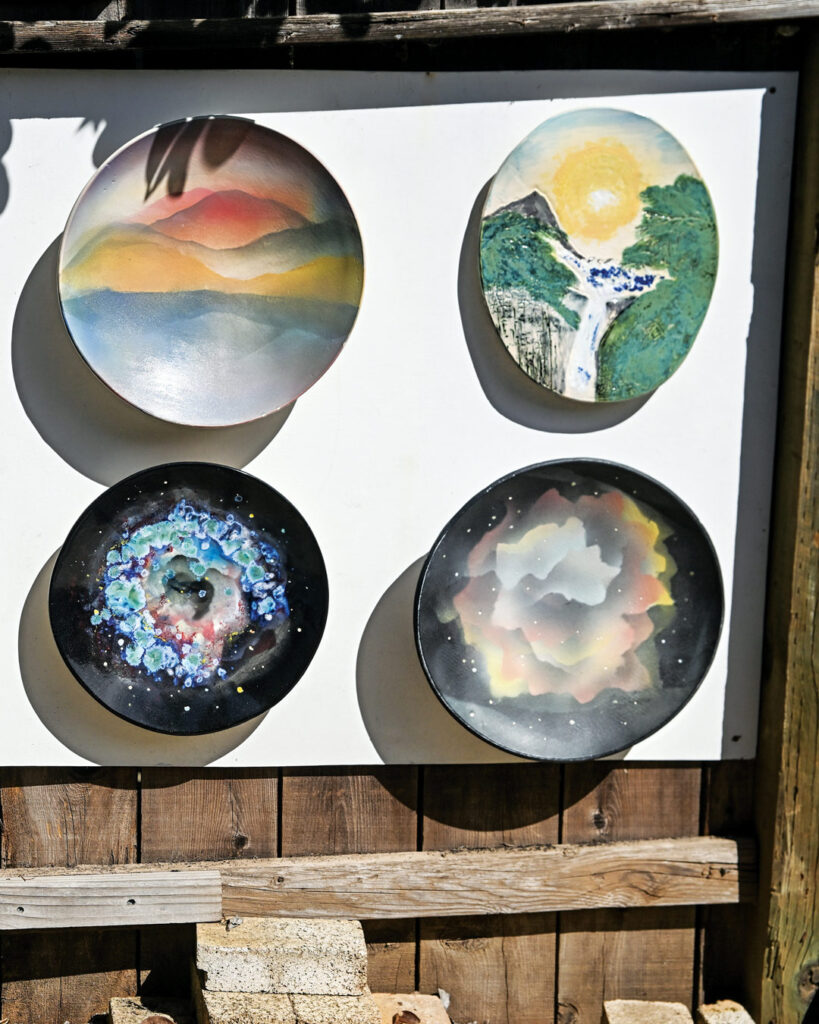
Over those three and a half decades, he taught hundreds of students the technical fundamentals of hand building and wheel throwing. But the deeper lesson was always something harder to put into a syllabus. “To let go,” he says, when asked what he most wanted students to carry with them. “Don’t worry about what you’re doing so much. Once you learn the techniques, get out of the way. Let the art flow.”
He carried the same philosophy into his own studio practice. “I would try to get out of the way,” he explains, “just get out of the way and let the muse or art spirit do the talking.” Another of his aphorisms cuts to the heart of it: “The artist’s primary product is emotion.” Technique is the vessel. Feeling is what fills it.
His writing spans genres with the same restless energy as his life. One of his most ambitious projects is a multi-volume “Novel History of Clay” series, teaching the history of ceramics through historical fiction that stretches from prehistoric times through ancient Mesopotamia and Egypt.
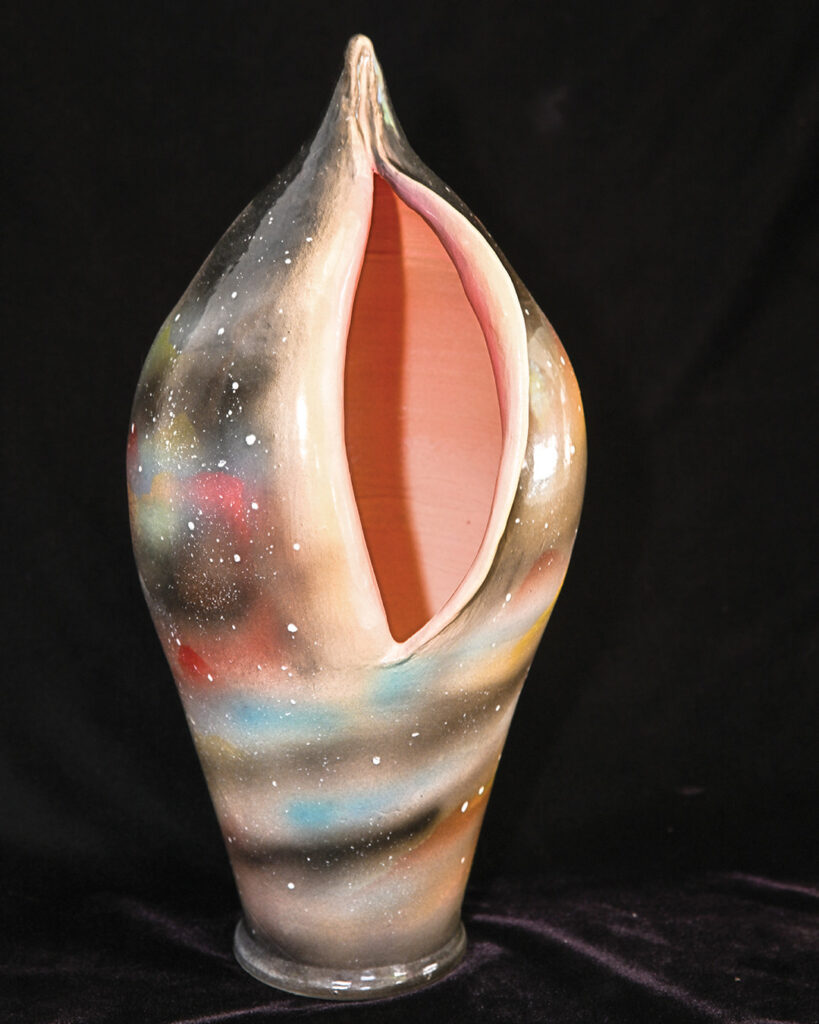
Asked what single thread runs through all of it—the science, the art, the travel, the clay, the writing—he answers without hesitation.
“Curiosity.”
At 85, Paul “Palul” Rideout is still at the wheel, still at the desk, still asking the large questions. He never picked a lane—and that, it turns out, was exactly the point. “I didn’t think of it so much as picking a lane,” he says. “I was trying to discover who I was.”
After years of scientific and artistic endeavors, the answer, it seems, is still gloriously, productively unfinished. Palul wouldn’t want it any other way. •
Article by
Al Olson loves culinary arts, adult beverages and hiking in the North State wilderness. You may find him soaking up the scenery at one of our area’s many state or national parks or sitting in a barstool sipping a cold locally brewed craft beer.


